CE marking without an ETA: how to read the declaration of performance
Jump through this article
A construction product can arrive at CE marking by two routes: via a harmonised standard or via a European Technical Assessment (ETA). According to the German Institute for Building Technology (DIBt), the Construction Products Regulation applies if a harmonised standard exists for the product or an ETA has been issued. Where there is no ETA, the manufacturer’s declaration is based on the harmonised standard; which one this is can be found in field 6 of the declaration of performance. Using the declaration of performance PSC250T-2026-01 as an example, this article shows how to read such a document.
What CE marking means
At its core, CE marking is a manufacturer’s declaration. By drawing up the declaration of performance (DoP), the manufacturer takes responsibility for the product conforming to the declared performance. How the performance is assessed and monitored is determined by the assessment and verification of constancy of performance system (AVCP). The manufacturer cannot choose it; it follows from the harmonised standard.
With System 3, a testing laboratory is involved; with System 4, all tasks lie with the manufacturer. The CE marking itself shows only the characteristics for which the manufacturer has declared a performance. The declaration of performance, by contrast, lists all characteristics that the standard provides for the declared intended use; where no performance is declared, it says “NPD” (no performance determined).
Which regulation applies?
According to the DIBt, the revised Construction Products Regulation (EU) 2024/3110 has been applicable across the board since 8 January 2026. For the declaration of performance, CE marking and the activity of notified bodies, however, parallel provisions apply.
The new procedures apply only once a product is covered by a harmonised standard, an EAD (European Assessment Document) or a fallback legal act under the 2024 version. For products whose standard was still drawn up under Regulation (EU) No 305/2011, the rules of that regulation continue to apply.
Structure of a declaration of performance
The template is in Annex III of the Regulation; according to the DIBt FAQ, the declaration of performance is to be drawn up using this template. The DoP PSC250T-2026-01 follows this structure:
| Field | Entry in PSC250T-2026-01 | What to look out for |
|---|---|---|
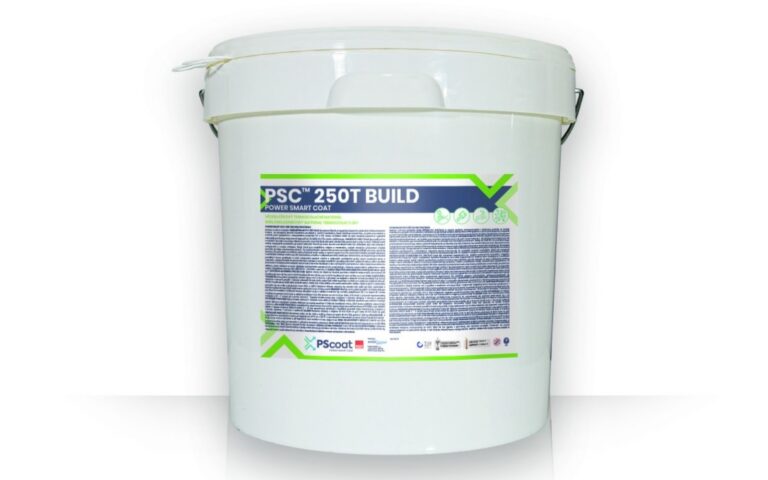
| 1 Identification code | PSC-250T/BUILD | The identification code links the declaration and the product and also appears behind the CE marking. It should match the container and the delivery note. |
| 2 Intended use | “Multi-component material for thermal insulation and for the protection of building surfaces” | Does the declared purpose cover the planned application? |
| 5 AVCP system | System 3 | A testing laboratory is involved. The test report should be requested from the supplier. |
| 6 Harmonised standard | EN 15824:2017-07 | The standard sets out the requirements for factory-made renders based on organic binders; it must be stated in field 6. |
| 7 Notified body | “Not applicable” | The evidence page lists as initial testing a report from the EFEKT laboratory, Zabrze, dated 16 May 2022. |
| 8 Declared performance | Binder, condition, water vapour permeability V1, water absorption W3, tensile bond strength | Only these characteristics are declared. Check the requirements from the design against them. |
| 9 Declaration | Ostrava, 1 April 2026; name and function of the signatory | The template requires the name of the signatory as well as place and date. |
How such class designations are to be read is explained in the article Reading the data sheet: what V and W classes really tell you.
What this declaration of performance does not contain
The DoP contains no declared performance for thermal conductivity or a U-value. Thermal data are found in other documents from the supplier, for example in the CE marking PSC 250 T, and there with the note that these are system performance values which do not correspond to the thermal conductivity of a material within the meaning of EN 12667 or EN 12664. The DIBt points out that information outside the CE marking must not mislead users about its meaning and must not contradict the required information. Whether a thermal value forms part of the declared performance is therefore shown only by the declaration of performance itself.
What purchasing should check
- Every customer is entitled to a copy of the declaration of performance. In Germany it must be made available in German.
- According to the DIBt, the distributor is to carry out a plausibility check: is information missing, or do figures obviously not fit together?
- According to the DIBt, the performance for a characteristic must be apparent from the declaration itself, without the help of further documents.
- The manufacturer keeps the declaration of performance for at least ten years from placing on the market.
Sources
- DIBt: BauPVO 2024 – Seit 8. Januar 2026 anwendbar (Construction Products Regulation 2024 – applicable since 8 January 2026) – 16 February 2026
- DIBt: Bauproduktenverordnung und Marktüberwachung (Construction Products Regulation and market surveillance; FAQ catalogue of the market surveillance authorities) – FAQ catalogue, page date as per the version accessed
- DIN EN 15824:2017-09 Festlegungen für Außen- und Innenputze mit organischen Bindemitteln (Specifications for external renders and internal plasters with organic binders) – edition 2017-09 (DIN Media/Beuth)
- Leistungserklärung (declaration of performance, DoP) no. PSC250T-2026-01, PSC-250T/BUILD – 1 April 2026
- Systemhandbuch PSC-FAS-001 (system manual; chapters 20/21: CE marking, declaration of performance) – version 1.0, June 2026 edition
- PScoat Nachweise (evidence): test reports, measurements, certificates – as at 12 October 2026
- CE marking PSC 250 T (EN 15824), declaration of performance no. PSC250T-2026-01 – 7 April 2026